|
 |
| |
Dangerous Liaisons: The Story

Source Novel • Choderlos de Laclos • Johnathan Daniel Steppe
• Libretto • Synopsis
|
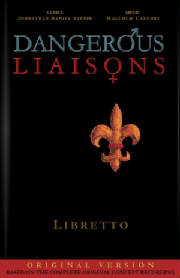
| Full Libretto |
| Complete Original Concept Recording |

|
| 3-CD Collectors Edition |
|
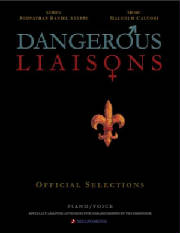
| Piano/Vocal Songbook |

The
Original Story
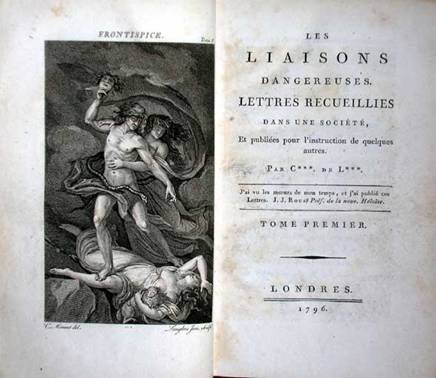
Dangerous Liaisons
began as the novel, Les Liaisons Dangereuses, by French author Choderlos de Laclos. Originally published
over two hundred years ago Les Liaisons Dangereuses was widely read at the time as a succès
de scandale (50 editions were published in his lifetime) and admired by readers such as Marie Antoinette, André
Gide and Charles Baudelaire. However, the story did not regain popularity until Christopher Hampton created the play that
was premiered in 1985 by the Royal Shakespeare Company at Stratford-on-Avon and later transferred to London’s West End
and New York’s Broadway. Wider popularity was assured by the release of the Stephen Frears’ film Dangerous
Liaisons with screenplay by Christopher Hampton in 1988, and Milos Foreman’s 1990 Valmont.
The reasons for the book’s neglect have less
to do with its qualities but more with its reputation. While famed as a lurid account of aristocratic sexual high jinks, it
is also an example of an outmoded form of writing. Serious readers in search of tragic uplift were disconcerted by the brilliant
comedy, and those seeking a more basic thrill were put off by the attention to psychological detail. The book is a series
of one hundred and seventy five letters through which the tale is recounted. The eighteenth century, in its leisure and literacy,
was a great age of letter writing. It is not surprising that the epistolary novel was one of the age’s most characteristic
literary forms, permitting a character to confide their innermost thoughts without the intervention of a formal narrative.
Letters could also be monotonously repetitious and contrived. Being an all important method of communication and a permanent
proof of deeds, the letter remains central to the action, even in the ballet version. 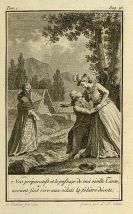
Christopher Hampton’s adaptation underlines the qualities
an audience expects of the eighteenth century, i.e. beautiful clothes and settings, witty dialogue and aristocratic frivolity.
This is in contrast to de Laclos who wrote in Mock-heroic style, which allows the writer to treat the most serious romantic
subject - sexual desire - in a most rigorous and classically comic manner. Valmont is the nearest the novel comes to a hero. Though we soon discover that Madame de Merteuil is really
in charge of the plot, Valmont dominates the action. He is certainly the most attractive figure in the book. Valmont perceives
his rejection of Tourvel, for whom he has a real love, as a sign of his freedom and power over women; in fact it is quite
the reverse. When he claims his prize of favors from Madame de Merteuil she refuses him pointing out that the victory is hers,
for it was her strength of will that persuaded Valmont to give up Tourvel. In the novel death is Valmont’s release,
Cecile becomes a nun, Danceny takes a vow of celibacy and joins the Knights of Malta and Mme. de Merteuil is financially ruined
and becomes hideously disfigured by smallpox.
|
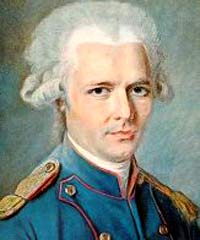
| Pierre Choderlos de Laclos |
Pierre
Ambrose Francois Choderlos de Laclos was born in 1741 and pursued a military career, becoming an accomplished artillery commander. It was while he was
assigned to a boring duty on a Bay of Biscay island at age forty that he determined, as he wrote to a friend, to use the time
to create something "out of the ordinary, eye-catching, something that would resound around the world" and live
after de Laclos’ death. The result was Les Liaisons Dangereuses, his first and only, and immediately
successful, novel. (His two other writings were a treatise on women’s education and an attack on Maréchal de
Vauban.) His sources for the story came from the time he spent in the garrison in Grenoble (1769 -75). There he observed the
local nobility, whose morals were extremely lax, although de Laclos himself did not have a reputation for behaving badly.
Instead he liked to talk with ladies and have them confide to him their love affairs. In 1784 de Laclos married the sister of an admiral, Solange Marie Duperré, who had
stated, after reading his book, that "Monsieur Laclos will never set foot in our drawing room." On hearing this
statement de Laclos declared that "Within six months I will marry Mademoiselle Duperré." His seduction and
conquest of Mlle. Duperré is probably the closest he ever came to being like his character Valmont. He proved to be
a devoted husband writing, "For nearly twenty years now I have owed my happiness to you..." During the French Revolution de Laclos was a Jacobin, a friend of Danton, secretary to "Philippe-Égalité"
the Duc d’Orléans. He was twice jailed, but the fall of Robespierre and the end of the Reign of Terror saved
him from the guillotine. At the turn of the century, Napoleon made de Laclos a brigadier general and assigned him to the Army
of the Rhine and then the Army in Italy. He was transferred to Naples and placed in charge of the defense of Taranto, where
he died of dysentery in 1803.
On Writing the Libretto to Dangerous Liaisons by Johnathan Daniel Steppe
The initial decision to adapt Dangerous Liaisons for the musical stage
was one borne out of the impulse and enthusiasm of youth. Two friends, fresh out of high school and hungry
to create, stumbled on Laclos' formidable and compelling novel. The story had all the right elements: passion,
intrigue, sex and betrayal. Certainly, this would make a great musical! Yet what began as a young dream
and now exists as a fully realized work, has since evolved and been tempered in the years through which the work was written.
It has become not simply a derivative of a great novel, but now stands as a unique and fascinating work in its own right.
When approaching the novel for adaptation, it was crucial to me as the librettist that the work be unique.
We of course wanted to remain true to Laclos, but at the same time wanted to create a musical that expanded the themes
presented by de Laclos, while filtering them through our own experiences and interests. I found myself
drawn to the roles in which men and women were cast during the time period of the novel, and how the stratification of gender
molded the characters of Valmont and the Marquise. Born into a culture which set men and women in an adversarial
position to one another, the two conspirators are born into their monstrosity. Still, it is difficult to
dismiss them as villains when one views the circumstances which gave them rise.
Another theme
which is expanded upon in the musical is the concept of the game. Dangerous Liaisons
is a story of intrigue, of the perilous games played between people when desires are suppressed and motives concealed.
The characters of the story are extremely passionate, yet exist in a time when passions were not to be openly expressed.
What happens to a person who is denied their passions? In Dangerous Liaisons,
the characters must resort to their hidden games, games that lead to a spider web of relationships pulled taught by unspoken
tensions.
With such a compelling story, endlessly complex characters, and controversial themes,
it becomes immediately obvious why Dangerous Liaisons drew me as a writer. What
might not be obvious is, why do a musical? Simply put, the natural poetry of the original work and the
heightened drama intrinsic to the storyline lends itself perfectly to musicalization. The music reveals
new levels to the story, expanding the audience's experience and understanding of each of the characters where simple words
could not. When successful, the melding of lyric and note is magical; it transcends the mundane and gives
us a greater form of storytelling.
As
a lyricist, I have been blessed with not only a truly great friend, but a truly great composer with which to collaborate.
What started as a dream is now a reality; where once there was nothing, there is now an exciting new musical to savor.
The process of writing a musical is breathtaking, heartbreaking, and nothing, yet everything, like I expected.
With each word written, the work changed. Each time the work changed, I changed. My
greatest wish for this work is that it will touch others the way that it has touched me. To touch others,
to change them, even if subtly - that is the greatest accomplishment that any artist can achieve.
In addition to having provided the libretto, Johnathan Daniel Steppe, himself a skilled actor and director,
also contributed to the Original Concept Recording by co-casting the principle roles, occasionally consulting as dialogue coach, and even singing in the chorus, where he can
be heard briefly as a cameo soloist.

| Click to Enlarge |
|
| Click to learn more |
Dangerous Liaisons Libretto
By Johnathan Daniel Steppe
Deceptive psychological maneuvering, irresistable
characters and true theatrical flair shine in this libretto to Dangerous Liaisons by writer, actor, director and
vocalist Johnathan Daniel Steppe. This special edition is based on the version presented in the Complete Original
Concept Recording. Grab your favorite chair and get ready for a fresh look at this notorious classic of scandal,
seduction and ruin. The perfect Dangerous Liaisons companion book, includes Foreword by the author, special editorials, Characters
and Original Recorded Cast credits and photos, Synopsis and bonus Production Diary from the making of the recording. Paperback,
5.5"x8.5", 208 pages.


PROLOGUE: "THE VOW"In the last days of pre-Revolutionary France, the aristocracy gather
for entertainment and scandal. Among them, the Vicomte de Valmont, and the Marquise de Merteuil, once lovers and still long-time
partners in secret games of seduction. The Marquise learns that a former lover who abandoned her for another has become engaged
to Cécile Volanges, the virginal daughter of her cousin, Madame de Volanges. Recognizing the girl as her opportunity,
the Marquise vows vengeance, and determines to enlist her confidante, the notorious Valmont, to take the young girl before
her marriage.
ACT I - PART 1
Valmont refuses to assist the Marquise in this
matter, confessing that he has already met his next conquest, the pious and happily married Madame de Tourvel, at the country
estate of his aunt, Madame de Rosemonde, where she is a guest. But his advances toward the Marquise inspire her to strike
a deal: one night of passion together as reward for his victory over Tourvel.
Turning
her attentions to Cécile, the Marquise orchestrates a secret meeting between Cécile and the Chevalier Dançeny,
a poor young music teacher who Madame de Volanges hires to instruct her daughter. Although Cécile and Dançeny
do fall in love, as the Marquise hoped, the Chevalier remains respectful of Cécile, and Cécile remains a virgin.
Meanwhile at the Rosemonde estate, Valmont succeeds, through a series of staged encounters,
in gaining Madame de Tourvel’s friendship. Knowing his reputation, Tourvel sees Valmont as a soul to be saved. Yet the
connection between them slowly grows deeper. Still, Valmont overplays his hand when he confesses his love to her, and she
asks that he leave the estate. Obliged by his own words, Valmont leaves the countryside. ACT
I - PART 2
Upon his return to Paris, Valmont agrees to take Cécile himself, as revenge
on her mother whom he had discovered was warning Tourvel against him. The Marquise devises a plan in which
Valmont can pursue both Cécile and Tourvel at the same time. She betrays Cécile’s correspondence with
Dançeny to the girl's mother, Volanges, advising her to accept an invitation to the Chateau Rosemonde, separating Cécile
from Dançeny. Volanges agrees, and the Marquise promises to join them shortly thereafter. Separately, she encourages
Cécile
to continue her liaison in secret. Now headed back to his aunt's, Valmont consoles Dançeny, promising
to deliver his letters to Cécile.

Valmont’s return to Rosemonde’s interrupts a supper party
and, as tensions mount, Valmont succeeds in upsetting Tourvel, who retreats to the garden for fresh air. He follows and, though
at first she spurns his presence, her growing feelings lead them to an uneasy reconciliation. She later begins to recognize
her growing vulnerability, as does Valmont, who confidently reassures the Marquise of his steady progress.
Fulfilling his other promise, Valmont
sneaks into Cécile’s room where he forces himself on her. Using blackmail and the girl’s own ignorance,
he succeeds in his dark seduction. Elsewhere, ignorant, Dançeny
optimistically holds on to the hope that he and Cécile
might yet have a future together. Distressed, Cécile turns to the recently arrived Marquise for help, who corrupts
her with advise to continue learning the art of lovemaking from Valmont, to free herself from her mother by agreeing to the
marriage, and to keep Dançeny as a secret lover.
A gala ball is given at the Rosemonde estate, where Tourvel finds herself on the brink of forbidden
love, Cécile wonders at the startling changes
her life has taken, and Valmont sees himself poised for victory. Ever the secret manipulator, the Marquise watches from afar,
all of her pawns in place and checkmate only a few moves away. 
INTERMEDIO: "REFLECTIONS"
In a letter written to Valmont, the Marquise recounts a sequence of experiences from her past.
She explains the evolution of her personal philosophy, attempting to rationally justify her uncompromising, wicked nature.
ACT IIValmont Continues his sexual education of Cécile, and his pursuit of Tourvel, who finally relents
to her growing attraction. Moved by compassion, however, Valmont hesitates and Tourvel flees the chateau at Rosemonde’s
insistence. Furious at his weakness, Valmont pursues Tourvel to Paris, where he and Tourvel at last give in to their passion.
As the Marquise entertains
her maid with storytelling, they are interrupted by Valmont, who attempts to claim his prize from the Marquise. She rejects
his demand and cancels their bargain, claiming that he is now in love with Tourvel. Later, as Volanges worries about her daughter’s
behavior, Valmont meanwhile cites his successful ruining of Cécile, who has now secretly miscarried, as further reason
why the Marquise should acquiesce. But the Marquise is adamant: Valmont must leave Tourvel and betray her love.
Tourvel has indeed fallen
in love with Valmont, and has broken from her husband. But when she joyously greets Valmont, he cruelly rejects her, fulfilling
the Marquise’s wishes. As Valmont rushes to the Marquise, Tourvel collapses from anguish. Still, the love that has grown
between Valmont and Tourvel creates a further rift between the two former lovers, and one-time allies begin a steady march
toward enmity. Valmont discovers Dançeny in the Marquise’s bed and, after sending the boy away, gives the Marquise
an ultimatum, which she fiercely rejects.
Moved by pride and now bent on revenge, Valmont and the Marquise turn their treachery upon each other.
As the climax approaches, secrets are revealed and passions explode with unexpected and deadly consequences. The resulting
endgame can have no victor, as the true price of this most dangerous game is at last revealed.




Benefit by working with the creators! Ask about Dangerous Liaisons Training Recordings
for your production. Get fully detailed custom music training led by the
composer and designed for the cast of the Original Concept Recording - now available
to you! Training includes 7 Principal Roles, Chorus (SA) and Chorus (TB)
Find more audio and photos, plus manuscript excerpts and other behind the
scenes background and goodies (collaborative conversations, cast auditions and more) in The Privy.
|
|
|