|
6/27/2014
Stuff You Never Knew About Music: Harp PedalsCompetant orchestration comes with many joys. I simply love the fine details marked in a score that indicate things that
people just wouldn't even think about! This is what "Stuff You Never Knew About Music" is all
about. We've all seen a harpist's fingers dancing impressively across the innumerable strings of their instrument. But
how many of you have ever noticed that their feet are also playing around on several pedals at the base of the harp? Pedals?
Yes. Like bass notes on an organ? No. Although there is such a thing as a "chromatic harp", the instrument
that we will typically see, and the one standard in the orchestra, is called a "double action harp", so called because
of its tuning and pedal mechanism. A chromatic harp, one which would would have a separate string for each chromatic note
- every note on the piano, black and white keys - would have LOTS of strings, and would make playing certain types of figurations
that we have come to expect from a "harp" impractical if not impossible. A double action harp doesn't have
a string for every note. Surprised? How do they play then, and what strings DO they have? Well, Consider your basic C major
scale that everyone can play on the piano. If your harp strings were like that, then it would make lots of things easier,
scales, runs, simple common chord formations, etc. But if your harp is tuned like a scale, then it's only good in the key
of that scale. There is an even bigger price to pay for this: Accidentals. The note A and the note B are one step apart,
right? But there is another note in between them, a "half-step" up or down from each. This note can be called either
A# (A Sharp) or Bb (B Flat), depending on the context of the notated harmony. But either way, it's the same pitch to our ear.
When we want to use notes that aren't a part of the key we're in, but our harp is tuned to the scale of the key, those extra
notes, those "accidentals" aren't on our harp. Enter the double action harp's pedal mechanism. 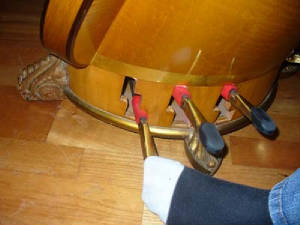 A major scale has eight notes, that is, seven distinct pitches and then a duplicate of the first at the end, an octave apart.
Any of these seven pitches can have a "sharp" version, a "natural" version and a "flat" version,
right? Well, there are seven pedals. Each controls one of the seven pitches - one for all the A's on the harp, one for all
the B's on the harp, etc. And each pedal can be adjusted into one of three grooves - a flat groove, a natural groove, and
a sharp groove. Pressing a pedal all the way down into the bottom groove tightens the strings associated with that pedal,
making them "sharp" notes. Springing the pedal loose and letting it rise to its highest position loosens the strings
associated with that pedal, making those strings - those notes - all "flat" in their tuning. The middle groove is
for "natural" pitches. A major scale has eight notes, that is, seven distinct pitches and then a duplicate of the first at the end, an octave apart.
Any of these seven pitches can have a "sharp" version, a "natural" version and a "flat" version,
right? Well, there are seven pedals. Each controls one of the seven pitches - one for all the A's on the harp, one for all
the B's on the harp, etc. And each pedal can be adjusted into one of three grooves - a flat groove, a natural groove, and
a sharp groove. Pressing a pedal all the way down into the bottom groove tightens the strings associated with that pedal,
making them "sharp" notes. Springing the pedal loose and letting it rise to its highest position loosens the strings
associated with that pedal, making those strings - those notes - all "flat" in their tuning. The middle groove is
for "natural" pitches.
So, any key signiture will clearly show a harpist which notes need to be sharp or
flat, and which need to be natural. And that harpist can easily set their pedals ahead of playing, and voila! they can play
in any key, not just the one key that their harp is tuned to (which, incidentally, is C flat major, all pedals up). But
again, what if you want to play those in between notes that aren't in the plain old scale? In order to get these notes, the
harpist must change the pedals as needed WHILE they are playing. There is a limit to how many pedals can be changed at once,
and to how quickly changes can be made. While a good orchestrator should know and understand the mechanics of any instrument
that he/she writes for, the harp - because of its pedals - has been a burden to avoid for many, and a fascinating game for
others. But the harp must be written for idiomatically; it is NOT a piano without keys. It's design lends itself to a particular
type of writing. Intricate and tricky virtuoso harp pedling doesn't necessarily make the music SOUND any more virtuosic, and
the great trouble that the performer goes to in such shifty, chromatic music is often lost on the listener entirely. Never-the-less,
harpists have an intimate relationship with their pedals, and will carefully mark their music with pedal markings - which
pedal(s) to change and WHEN, according to their own way of pedling. So even if an orchestrator doesn't write pedal markings
at all, leaving it to the harpist, they still need to understand what they're asking for from the performer, and if it's reasonable.
I write pedal markings, because it makes me sure that I'm paying attention to what I'm asking, and it makes me more fluent
in my understanding, through exercise. The harpist can still make markings of their own - they will anyhow - and I'm not offended.
12/5/2011
DANGEROUS LIAISONS PUBLIC UPDATE 12/05/11BIG NEWS Alright
everyone, if you haven’t already gotten the word, THE time has arrived! Since my last update, the 3 master discs
have delivered for duplication, and the package designs and booklet insert are being printed.
 Because of the thickness of the booklet (56 pages, with color photos and complete reprint of the libretto),
the physical CD case cannot be your standard case, even though there are some slim-line cases available that do hold 3 discs.
The book just won’t fit in a slim case. So because the double-wide “chubby” cases (as they’re called)
are required, and because the booklet printing is also an extra job that isn’t part of a typical release, there is some
additional preparation work in putting this special release together. But I am expecting to have all materials assembled and
wrapped by week’s end for next Tuesday’s release. The official release date (CDs are always released on
a Tuesday) is 12/13/11. Because of the thickness of the booklet (56 pages, with color photos and complete reprint of the libretto),
the physical CD case cannot be your standard case, even though there are some slim-line cases available that do hold 3 discs.
The book just won’t fit in a slim case. So because the double-wide “chubby” cases (as they’re called)
are required, and because the booklet printing is also an extra job that isn’t part of a typical release, there is some
additional preparation work in putting this special release together. But I am expecting to have all materials assembled and
wrapped by week’s end for next Tuesday’s release. The official release date (CDs are always released on
a Tuesday) is 12/13/11.
SO IT’S HERE! Pre-orders are being excepted right now, but for the time being, exclusively
only at www.melpomenemusicgroup.com. (lots of clips to hear at www.melpomenemusicgroup.com/dlocr.html) Distribution (and thus exposure) will widen some probably around March, give or take. In the meantime though, no one will
know about it unless they get word of mouth. SO!
I know the recorded cast members share some excitement with Johnathan
and I about the release, but I’d like to encourage EVERYONE getting this message to spread the word!
We all know people who love musical theatre, and hunger for quality shows they don’t already know. THIS is one they
don’t know! And won’t have even heard that it’s available. A perfect scenario for surprise Christmas presents
for your friends, but also our best target demographic for getting the word out to those that would love to hear about it.
Please let people know about it.
To cast members, remember: Pursuant to the compensation clause in your contract
agreements, you are each entitled to, and Melpomene is obligated to make it’s best effort to provide, one copy of the
finished product. If any of you cant wait until you get you own and purchase one right away, or if you’ve already purchased
a copy, that’s fine, just know that you’ve got another one coming to you that you will be able to give to someone
else, if you like.
A couple of additional items:
1) One of the next things
coming up in all of this is, of course, the Cast-Reunion/Release party. This is where those cast who are still local
(and all others, too…) will be invited to get together for food and fun, but more importantly, to get your copies and
to finally hear the whole show! Non-cast members are probably not aware that even the cast have only heard the parts that
they are in, and haven’t even heard THOSE sections with all the component pieces put together! So it’ll be a free
night of high class drama! I haven’t decided yet, but I may also strategically invite others to this “event”
as well. But I DO know that we will be waiting until AFTER the holiday madness to schlurp it’s way safely past us (don’t
look that word up, I just invented it). When this update originally was sent out,
I forgot: There is no official venue for this event! Please send suggestions, or if you have contacts or access to a space!
(30-50 people)!
2) Also this week, I should be receiving some
sizzle cards, little post-card sort of things announcing the arrival of the recording. They look very nice, and I’ll
be planning on leaving small stacks on the counters of theatres around the metro area. Please send me suggestions for theatres
where audiences appreciate “musicals” not just straight theatre, as well as theatres with whom you may have worked
where people might recognize your name on the card (this applies to the 7 principal roles, plus Tad Wilson).
3)
Some of you may have already noticed this, but, TA-DA! There’s already a vocal selections book ready and available as
well! (http://www.melpomenemusicgroup.com/catalog/i7.html) It’s a really beautiful special edition, and a perfect item for those of you who are always looking for fresh and
less used audition repertoire, or for those of you who love to collect such mementos. It’s REALLY cheap
right now too, when you get the CD.
4) Does ANYONE actually KNOW Tony Cimafranca!?
I don’t think he’s a regular local actor, but that he showed up at our auditions on a whim. Anyway, we cast him,
and although people’s email addresses and phone numbers have changed over time, I believe he is the only one with whom
I’ve completely lost contact. None of his info seems to still lead to him. Anyone know how to find him?
Well,
It’s certainly been a long haul to get here, but I knew we would! Now, I also know that the stage is waiting in the
future! I’m not very familiar with how to go about getting the thing on stage, so anyone with personal experience and/or
knowledge of the typical various processes, I’d appreciate your input! I do have a few ideas regarding venues that I
think would be appropriate for various reasons, but how it all happens I’m looking forward to learning about.
Remember too that this show has a big ensemble, so any of you who are in choruses and choirs, etc., consider how your group
may also be interested in the show, by perhaps teaming up with a local theatre company or such. Great way to show community
and to double your audiences when organizations work together.
Words like “readings”, “workshops”,
“backers auditions”, “submissions”, etc. I do have some familiarity with. And although I’m very
open to a smaller first performance and even a concert version (could be fun!), I’m not sure that a mere reading or
perhaps even a workshop is necessarily the best next thing. We’ve kind of covered that ground with the recording. And
backers auditions, if I got this right, is for finding investors to fund a particular production, so that would be up to the
director or producer to arrange, not me.
We’ll take things as they come, but, as always, PRESS ON! Let’s
see how quickly we can get this thing up and running LIVE! Meanwhile I’ll be working on completing the engraving of
the full orchestral score and the accompanying sheet music parts for the pit orchestra.
Boy! I think that’s
everything. If I’ve left anything out, it’ll hit me as soon as I hit “send” (see underlined note above).
Love to all for your ongoing support. Tell all you know! For now, it’s basically the only way anyone will know that
there is now a great new DANGEROUS LIAISONS ready to “schlurp” with immense satisfaction!
11/29/2011
Dangerous Liaisons CD - Official Release Date!OK, folks! Manufacture has been ordered, so.... Here's the OFFICIAL announcement! Dangerous Liaisons - Complete
Original Concept recording Release Date: 12/13/2011 Pre-release orders may be placed now. Shipment will be made on or before the official release date, in time for the holidays. And that's a nice thing
too, because what do you get your fellow theatre pals, and musical fans, when they've already got everything out there? As
you'll see at the website, "BRAND NEW - Your musical-loving friends don't have THIS show yet!" So surprise them
with a dramatic wollop they never saw coming! I'll note also that there is already a Piano/Vocal Selections songbook available as well, including 10 stand-alone numbers from the show, solos and duets for all voice types. It's a beautiful
special edition that would also make a great addition to any collection. (A hint to all youz guyz constantly looking
for unique audition material.) As for the recorded cast members, I'll remind you that I am contractually obligated
to provide you with a copy of the recording. You'll have the opportunity to collect yours at the cast reunion/listening
party, when we'll finally get to hear the whole show all put together! This will be sometime in the early new year, I would
presume, after the holidays clear outta here. We'll be working on that next. Anyone able to recommend/provide a suitable venue
(probably 35-45 people)? I know that some cast have moved away, and I'll be attempting to make alternate arrangements
with them. Well, here we are, can you BELIEVE it!? Next task... take it to the stage!
7/24/2011
CD Release: Dangerous Liaisons the musicalHello all, Just wanted to put the word out to everyone that I plan to have the CD released to the public before
the end of August, 2011. That's just around the corner! It was originally due out last October, but was postponed
as a part of some logistical strategy. That now is cleared, and plans are being made for the production of consumer-ready
versions of the show's entire original concept. Initially, the recording will be available exclusively only at www.MelpomeneMusicGroup.com, although distribution will widen later. This is merely an update. A formal announcement will of course be forthcoming
in the weeks ahead. Thanks to everyone who helped realize this performance! Malcolm Caluori
3/15/2011
Stuff You Never Knew About Music: Violin StringsCompetant orchestration comes with many joys. I simply love the fine details marked in a score that indicate things that
people just wouldn't even think about! This is what "Stuff You Never Knew About Music" is all about.
I'm
sure you could figure out that the four strings of a violin (or any of the instruments in its family) plays the low notes
on the low string (G) and the highest notes on the high string (E), and moves from the lower strings to higher strings as
the music gets higher, right? But did you know that sometimes a composer will specifically indicate that a passage of music
be played on a particular string? You may have heard of Bach's "Air on the G String" (the violin piece, not a fan
blowing a bikini). Why would a composer do this?
Well, firstly, a violinist can play most notes in more than
one way, unlike a piano where you can only make middle C sound if you hit the ONE correct key on the keyboard. If for example,
a violinist wishes to play the F on the top line of the music staff, it can be played on ANY one of the four strings. The
lower strings simply require that the hand move further up the fingerboard in order to make the string short enough to produce
the higher note. Simple enough, right? But the question is "why"?
Primarily, there are two reasons. Did
you ever think about the fact that since the lower strings are thicker than the higher strings, yes they all sound like a
violin, but they each have their own subtle character. Without analyzing them individually here, let it be broadly stated
that a thicker, wound chord of catgut (like the lowest string, G) will generally produce a ... fuller ... richer sonority
than a thin string (like the highest string, E, which is practically a wire). Makes sense.
But if you recall
that playing a particular passage of music on a lower string requires your hand to move up the fingerboard to a higher "position",
thereby shortening the string, you will instantly understand that a short string vibrates much faster than an "open"
string, and thereby tends to express a much more intense energy in its sound than if you played the very same notes on a higher
string but with the hand in a lower position. Get it?
Since there is not usually only one way to play a passage
of music on a violin, the performer is generally free to sort through the available options when playing through the music,
in order to facilitate the easiest or most effective manner to do the job. But, sometimes the composer will specifically ask
for a passage to be played on a particular string, in order to ensure a particular intended result.
Other reasons
include the fact that, since the fingers are also used to create vibrato, by wiggling the hand while playing a note, if
you play a note on an open string, where the fingers are not used, then you cannot produce vibrato. This dry effect is sometimes
also specifically intended, and so a performer will be instructed to play the note without vibrato, or on the open string.
But this is also another time that the sheet music might ask for playing on a lower string. If, say, a passage contains
alot of E's, or sustains a held E for a while, and the composer does NOT want that dry sound of the open string to interrupt
the continuity with the other notes in the passage, but wishes to ensure that a pleasant vibrato may be sounded, then he will
be sure to mark the music so that the passage is played elsewhere than on the E string, so that the fingers must always
be used. Did you ever think about that? Very clever.
8/30/2010
DANGEROUS LIAISONS UPDATE 08/10/2010WOW! It's 08/10/10, everyone. How time flies! The Collaborators, when Dangerous Liaisons began
My very dear Dangerous
Liaisons cast and project followers, the time draws very near, indeed! While I like to send you these updates at every step
along the way, the "mixing" step for this recording has lasted so long that you haven't heard much since our ACT
I EXPOSITION listening party. (That was fun.) But now, since you are hearing from me again, guess what that means ... The
Mixing is done! True, after the break-in and loss of equipment, hardware, software and the ACT I working data, the newly completed
ACT II mix does not quite match the acoustic of what remained to us of the ACT I mix. In fact, it sounds better. It sounds
fantastic! I just wish that I still had the working files for ACT I, so that I could put that final polishing on it as well.
But we'll live with those differences instead of starting the ACT I mixing work all over from scratch, eh? (For the time being
anyway; perhaps one day, I'll do a nice "Remastered Release" of the recording. But for now, LET THE MARKETING BEGIN!) Now,
I'm not talking about the marketing of the recording so much as using the recording to begin the marketing of the show for
production. So now that the "Mixing" step is complete, the next step is the "Mastering" of the entire
audio stream of the show, into the 3CD set that you've all been waiting for. A new step, and thus a new Public Update. But
guess what? ... The Mastering is done, too!! Due to the nature of the project, a good deal of the work of mastering
was completed along with the mixing work. So when the time for mastering actually came, the process went much faster than
I had anticipated. Basically all that was left to do for the mastering was to balance the volume from scene to scene, so that
they all sounded at the same level, and then chop the whole thing up into CD tracks. Burn and BANG! You got your Masters.
All three of 'em! SOOooo ... The NEXT step: The packaging and insert prototypes have already been developed and in place
for some time now. Updating the CD case's back cover contents will take, oh, a few minutes. So now I am working on the larger
job of completing the insert booklet. As you recall, this will be where the entire recorded cast will be credited by name.
It will also contain Principle Role headshots, the complete libretto, etc. The thing that makes the task a bit longer
is that the libretto cannot simply be cut and pasted, or else the booklet would be WAY too fat. The libretto must be completely
reformatted for CD insert presentation. But the libretto IS already written, so it's only the reformatting that needs to be
done, and I'm guessing that that will take, maybe, a month at best. The rest of the booklet won't take long to design at all
- just a few days. With the packaging in place, and the CD labels designed (also a quick job), all that remains is the duplicating
of the packaging and the CDs, and we're off and rolling! ATTEND THE DANGEROUS LIAISONS EXPO!! All
of this means that we're just about ready for the next get together, to finally hear the whole show! And to get your copies!
And to make the formal premier introduction of the musical Dangerous Liaisons to the world! Be thinking about this meeting,
and please DO send your suggestions for possible venues. This time there will be a bigger group, assuming that all (still-local)
cast members attend, including, perhaps, some industry folks and others. So, so happy to be finally making this announcement, Malcolm
Caluori Composer, Project Coordinator Melpomene Music Group P.S. If you haven't visited
the new website, it's much improved. Though still under construction while other tasks are more pressing, the Dangerous Liaisons
sections of the site are pretty complete. And you can listen to clips from the recording. Take a look, sign in (for free)
and let me know that you visited! http://www.melpomenemusicgroup.com/
5/4/2010
Unlimited Possibilities are Ours for the ChoosingA tremendous influence on my musical education has come from Leonard Bernstein's Norton Lectures "The Unanswered
Question" from the early 1970s. Indeed much (if not most) of my compositional aesthetic comes from what I learn from
this series of lectures. Through more recent sources of study, I have been able to glean a bearing on musical history and
musical development from additional perspectives, including not only on how music itself developed through time, but also
some more (in addition to the Bernstein) on how individual composers developed their own theories, principles and approaches
to music, its composition, its function and purpose, its possibilities, etc. All of this has brought me to contemplate my
own artistic principles as a composer. Not to say what is right or wrong about what other composers have done. What they chose
was right for them and it is not for me to judge, but to understand their concepts and to refine my own.
Now after
these studies, I have once again sat down to the Bernstein with "fresher" ears. Already at the beginning of Lecture
one, I am inspired with thought -- even after so many years of studying and listening to these Norton Lectures. Does music
express to our ears the human emotions which we universally share? My thinking is "no". It is, rather, that our
emotions can, through our creativity (and musicianship) be expressed musically. I agree that music does not carry literal
semantic meaning, nor does it convey specifically defined emotional content. It can be interpreted this way, but how it is
intended when it is first conceived is the question. When we listen to music, are we experiencing a virtual reality equivalent
to the composer's when it was written? No. we are getting only his musical expression of what he felt, and this could mean
different things to our ears, through our own experience.
But emotionalism is only one mode of approach. Not all
music is inspired by a desire to express "emotion." But, in terms of opera -- or more specifically, vocal music
-- when words are accompanied by music, the emotional content can be more specifically percieved and the words therefore made
more powerful. In considering recitative, this is often a "non-emotional" style of composition, but it is also joined
with words. How does this affect those words? My suspicion is that neither an emotional OR non-emotional approach is the better
choice, but as according to and directed by the composer's intended interpretation of the text (or dramatic flow). It becomes,
rather, a question NOT of which is the best choice for one's compositional style, but which is more appropriate at any given
point [in the text/drama].
The reason that this is my suspicion is because I was reaching very similar conclusions
with regard to a number of other musical aspects during the course of my more recent studies. That is, "this way or that
way? This compositional approach / aesthetic principle / dramatic ideology / etc., or that one?" The answer usually seemed
to be that all methods have their virtues, it is more a matter of using the one which is most suitable for any given
segment of one's creation.
Therefore, to make a VERY general sort of example, with a question like: Tonal, modal
or serial? In light of the progressing evolution of music, which should a composer choose for writing music for today
(and for the ages)? Should one continue in the Romantic line, one would be accused of lack of innovation or of being "old-news"
and risk obscurity, if not be ignored entirely. Is that true? If being "modern" means atonality, dissonance,
and the like, then one risks equal neglect for lack of listeners. Is that true? How to write music that is pleasing and wants
to be heard, and not be old-hat? It seems to me that the collective history and development of music should not stump us for
where to go next, but should instead be considered the largest culmination of choices available to the composer to date! The
real idea, it seems to me, is to know all of these various options, and to know that the right one to use is whichever one
best suits your intent for any given moment of music.
So, Tonality or Modality? Serialism? Polyrhythmic & Bi-tonal;
contrapuntal, homophonic, mixed- or even-metered? In fact, all possible compositional options... The answer is "Yes."
In this respect, Bernstein would seem to be right when, in his ultimate summation, he foresees "an eclecticism in the
highest sense."
In considering dramatic works specifically, as a current preoccupation of mine, this approach
seems logical, as if it should have been obvious all along. Don't fret and bother over breaking new ground. If you walk into
that, then congratulations. But the point is to be able to create in a "natural" way -- that is, not to fight one's
instincts (unless forced art is the particular point you may happen to be making). Create for yourself first.
Choice
permeates all aspects of creativity, and so it is with dramatic composition: recitative or none?, arias or not?, "musikdrama"!?
Follow Verdi's evolution and where are we going by extension? Ah, there we're caught in the trap again. No. Keep a full toolbox
and choose your tool as best fits the expression you seek. What about libretti? Again, arias? Why not, if it feels appropriate?
To rhyme or not to rhyme? Which metrical structures, or none at all? Same thing: there will be times for all types of
application; which one is right for this particular moment?
The joy of the creative process involves drawing from
all applications at one's disposal, as one pleases. The best way to confront the greatest number of possible expressions,
is to command a great number of modes of expression. That this seems all so obvious enough, merely reinforces my feeling that
it's ok to write music naturally, instinctively, rather than stewing over the intellectualized aspects of music making --
not that naturally composed music should not exude intelligence. In fact, I think that the music I most enjoy has an intellectual
quality. Intellect is nature too, you know.
11:41 pm edt
3/29/2010
The "Chicken & the Egg" of Music & LyricsWherever words and music are melded, the vocal curious inevitably ask the ever present question of the author(s): "Which
comes first, the music or the lyric?" The answer may vary from collaborative team to team, from single artist to single
artist, but also from work to work. This is why the question persists time and time again. Both music and lyric each may come
first, and no given answer is necessarily permanent from creation to creation.
As for myself, I have found myself
in both positions even within a single project. Dangerous Liaisons was such a varied score and had so many numbers that there
were multiple approaches that were undertaken. The score to Liaisons is tightly woven with leitmotif and thematic
intricacies. Clearly the major musical themes were to be supplied by the free-standing songs and set pieces, so these
had to come before the "scenes", the more plot driven moments of the show. But sometimes I was so inspired
by a number's concept that I wrote the music first, so that I could be sure to integrate my specific musical concepts, and
sometimes Johnathan would be drawn to write lyrics for numbers before I set them to music.
And so the major thematic
chunks were born, and as the work continued into the intermittent gaps, the "scenes", my experience on both sides
of the egg taught me that I enjoyed both. I appreciated working from a section of libretto, where I had specific words
in front of me, providing an overall arc to the number and also a moment to moment "script" for me to interpret
dramatically. I found that having words first had a great deal of influence on the nature of the melodies I created.
Not only rhythmically and formally, having to deal with the meters and form provided in the lyrics, but also from word to
word, as I chose my interpretation and how to express it within the structural boundaries defined by the lyric.
But
I also found that writing the music first left me complete freedom, without any predefined boundaries to influence my free
creative expression. While the lyric was often regarded as a comforting guide, providing a starting point that the blank
page cannot provide, composing the music first was not always daunting when the project itself is an inspiration.
This lesson, the pros and cons of both sides, called forth a desire within me for a method which gave me the best of both
worlds, creatively. One which allowed both composer and librettist the complete artistic freedom of "going first",
one which gave me specific, moment to moment inspiration throughout a scene allowing me to compose music precise to the drama
without the structural bonds of a pre-existing libretto. It is this method that was reserved for the most important
moments of the show. How does it work?
First of all, being the most important moments in the show, the most
dramatically charged or pivotal, these moments were not approached until all other numbers were completed first. This
assured that all possible themes from throughout the show were available to be drawn upon for use in these moments, the
broadest possible relevant palette. It allowed for our ideas on character development to have first fully matured.
When it was time, we followed the method I created this way: Johnathan would first write a prose version of the scene,
allowing him full reign over dramatic arc, progression of dialogue, and over all scene construction. This prose version
showed me exactly what was in the scene, and the exact order that it happened. I then would compose music following
this specific road map, but with full musical freedom, thematically, rhythmically, and structurally, and writing musical vocal
lines sufficient to express the prose words presented to me. After enjoying the pleasure of meticulously constructing
a finely tailored score, the vocalists' lyrics would then finally be filled into the score by the librettist, following
the prose model of the scene and using the melodic material I'd composed for each line.
Though the method does
call for an extra step on the part of the librettist, the experience proved to be so enjoyable and successful that Johnathan
has even suggested that he would be willing to approach an entire stagework this way, while I still feel that the method
serves best for "scenes" than for "songs", and is more useful when reserved for crucial dramatic moments.
So, when the question is put to me, music first or lyrics? I'm no longer sure that I even consider the question itself
valid. Both have their merits. I believe that this is but one more artistic choice, and in my book, all artistic
choices should be considered as "tools". The master's challenge is to know not only how to use each tool
in the box effectively, but just as importantly, when to use which.
|

|
2014.06.01
2011.12.01
2011.11.01
2011.07.01
2011.03.01
2010.08.01
2010.05.01
2010.03.01

|